









Bestclinicabroad
Connect with the world's Best Clinic and doctors at Best Clinic Abroad. Your well-being is our priority, with personalized care every step of the way.


Connect with the world's Best Clinic and doctors at Best Clinic Abroad. Your well-being is our priority, with personalized care every step of the way.


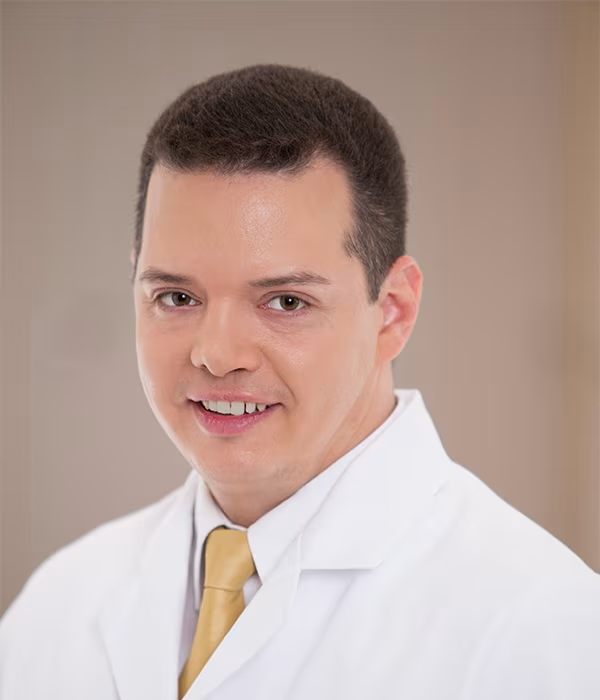
Dr. Alexander Fous is a renowned ophthalmologist in Austria, recognized as one of the top eye doctors in Vienna for his dedication to eye health and vision care. Practicing at Dobling Private Hospital, he combines cutting-edge technology with patient-focused treatment, offering comprehensive ophthalmology services. As a leading eye specialist in Austria, he provides advanced solutions for various vision disorders, making him a famous ophthalmologist in Vienna known for his expertise and patient-centered approach.
Price upon request
Vision impairment remains a significant global health concern. According to the World Health Organization (WHO), at least 2.2 billion people worldwide live with some form of vision impairment or blindness. Common conditions include cataracts, glaucoma, age-related macular degeneration, diabetic retinopathy, and refractive errors. Early diagnosis and appropriate ophthalmic care can help prevent complications and preserve visual function. As eye care technologies advance, including laser-assisted procedures and microsurgical techniques, some patients consider traveling abroad to seek specialized ophthalmology services.
Austria has a well-regulated healthcare system with strict professional licensing requirements and adherence to European Union medical standards. Eye specialists, also known as ophthalmologists, complete formal medical education followed by specialist training in ophthalmology. Clinical practice follows internationally recognized guidelines for cataract surgery, glaucoma management, retinal disease treatment, and corneal procedures. Infection control, surgical sterility, and patient safety protocols are closely monitored in both public and private healthcare institutions.
Major cities such as Vienna, Graz, Innsbruck, Salzburg, and Linz host university hospitals and specialized eye clinics equipped with advanced diagnostic imaging, including optical coherence tomography (OCT), visual field testing, and microsurgical operating systems. Multidisciplinary collaboration is common, particularly for patients with diabetes or systemic diseases affecting vision.
For international patients considering eye specialists in Austria, evaluation typically includes comprehensive eye examination and imaging studies. Physicians discuss available treatment options, potential risks, expected outcomes, and limitations. Emotional reassurance is balanced with evidence-based medical information. Austria’s regulated infrastructure provides a structured and safety-focused environment for ophthalmic care.
Prof. Dr. Susanne Binder, MD
Specialization: Retinal Diseases and Vitreoretinal Surgery
Years of Experience: 30+ years
Prof. Dr. Susanne Binder practices at Vienna General Hospital (AKH Wien). Her clinical focus includes macular degeneration, retinal detachment, and diabetic retinopathy. She works within a university hospital equipped with advanced retinal imaging technologies. Treatment plans follow established European ophthalmology guidelines. Multidisciplinary collaboration is part of her clinical approach.
Prof. Dr. Michael Amon, MD
Specialization: Cataract and Refractive Surgery
Years of Experience: 30+ years
Prof. Dr. Michael Amon is affiliated with Hanusch Hospital Vienna. His expertise includes cataract surgery and intraocular lens implantation. He practices in a structured surgical environment with standardized sterility protocols. Preoperative evaluation and patient counseling are integral components of care.
Prof. Dr. Ursula Schmidt-Erfurth, MD
Specialization: Macular and Retinal Disorders
Years of Experience: 30+ years
Prof. Dr. Ursula Schmidt-Erfurth works at Medical University of Vienna. Her areas of focus include age-related macular degeneration and retinal imaging. She practices in a tertiary academic center with advanced diagnostic capabilities. Clinical management aligns with international retinal treatment guidelines.
Prof. Dr. Oliver Findl, MD
Specialization: Cataract and Intraocular Lens Surgery
Years of Experience: 25+ years
Prof. Dr. Oliver Findl practices at Vienna Institute for Research in Ocular Surgery. His expertise includes cataract procedures and lens research. Surgical planning involves detailed biometric measurements. Patient safety and realistic outcome discussions are prioritized.
Prof. Dr. Gerhard Garhöfer, MD
Specialization: Glaucoma and Ocular Blood Flow
Years of Experience: 20+ years
Prof. Dr. Gerhard Garhöfer is associated with the Medical University of Vienna. His clinical interests include glaucoma diagnosis and medical management. He works within structured ophthalmology units equipped with visual field and imaging technologies. Treatment decisions are individualized based on disease progression.
Prof. Dr. Stefan Sacu, MD
Specialization: Retinal and Macular Surgery
Years of Experience: 20+ years
Prof. Dr. Stefan Sacu practices at Vienna General Hospital (AKH Wien). His areas of focus include vitreoretinal surgery and retinal vascular disorders. He operates in an advanced microsurgical setting. Clinical protocols emphasize careful risk assessment and postoperative monitoring.
Prof. Dr. Rupert Menapace, MD
Specialization: Cataract and Anterior Segment Surgery
Years of Experience: 30+ years
Prof. Dr. Rupert Menapace is affiliated with Medical University of Vienna. His expertise includes complex cataract cases and anterior segment reconstruction. Surgical care follows established European standards. Detailed preoperative assessment is part of routine practice.
Prof. Dr. Andreas Wedrich, MD
Specialization: Retinal Surgery and Ocular Trauma
Years of Experience: 25+ years
Prof. Dr. Andreas Wedrich works at Medical University of Graz. His clinical focus includes retinal detachment repair and ocular trauma management. He practices within a university-based ophthalmology department. Multidisciplinary care is coordinated when systemic conditions are involved.
The following ophthalmologists are listed for informational purposes only and are not ranked.
| Consultation Type | Estimated Cost Range |
| Eye specialist consultation | $150–$350 |
Note: Costs are approximate and provided for general guidance only. Prices vary depending on the healthcare provider, hospital type, city, and consultation format (in-person or remote). Diagnostic tests, imaging, or additional evaluations are not included. Final fees are determined by the provider after an individual clinical assessment and may be affected by currency fluctuations.
Choosing an eye specialist abroad requires careful consideration, especially when vision is affected. You may want reassurance regarding medical training, surgical safety, and how your treatment will be coordinated. Understanding Austria’s healthcare structure can help you make an informed decision.
➤ Availability of English-speaking medical staff and professional medical translators in many facilities
➤ Specialized clinics that manage a high volume of international patients
➤ Government regulations and oversight mechanisms supporting medical tourism safety and international patient protection
➤ Structured hospital documentation, patient-safety protocols, and informed consent practices
International patients should review visa or entry requirements based on nationality and planned length of stay. For surgical procedures such as cataract or retinal surgery, a postoperative stay of 7–14 days may be recommended depending on recovery and follow-up needs. English is widely spoken in major cities, but communication may vary in smaller regions. Planning follow-up eye examinations with your local ophthalmologist after returning home is important for long-term visual health.
Patients considering ophthalmology care in Austria may share their eye examination reports, imaging results, and medical history with Best Clinic Abroad to receive assistance in coordinating consultations and understanding the initial evaluation process with licensed eye specialists.
Do I need visa assistance for eye treatment in Austria?
Visa requirements depend on your nationality and the duration of your stay. Austria is part of the Schengen Area, so medical visits generally follow Schengen visa regulations. You should contact the Austrian embassy or consulate in your country for updated information. Clinics may provide appointment confirmation documents, but visa approval decisions are made by immigration authorities.
Do eye specialists in Austria speak English?
Many ophthalmologists working in university hospitals and private eye clinics communicate in English, especially when treating international patients. English is widely used in medical education and research. However, proficiency may vary outside major urban centers. Professional medical interpreters can often be arranged if needed.
Is online consultation available before traveling to Austria for eye treatment?
Yes, online consultation is often available for international patients seeking ophthalmology care in Austria. If you coordinate your case through Best Clinic Abroad, their team can assist in arranging an online consultation with a licensed eye specialist. You may be asked to submit eye examination reports, imaging results, and medical records for review. Final treatment decisions are typically made after an in-person eye examination and diagnostic testing.
How long should I stay in Austria after eye surgery?
The recommended stay depends on the type of procedure. Some minor procedures may require only short follow-up visits, while more complex retinal surgeries may require longer monitoring. Many patients are advised to remain in Austria for several days to two weeks after surgery for early postoperative evaluation. Your ophthalmologist will provide individualized guidance.
Can follow-up care continue in my home country after eye treatment in Austria?
Yes, follow-up care can often be coordinated with your local ophthalmologist after you return home. It is important to obtain detailed surgical reports and medication instructions before traveling. Some specialists may offer remote follow-up consultations when clinically appropriate. Ongoing monitoring is important for long-term eye health.
Disclaimer
This content is provided for informational purposes only and does not constitute medical advice. Diagnosis and treatment decisions should be made in consultation with a licensed medical specialist based on individual clinical evaluation.


