









Bestclinicabroad
Connect with the world's Best Clinic and doctors at Best Clinic Abroad. Your well-being is our priority, with personalized care every step of the way.


Connect with the world's Best Clinic and doctors at Best Clinic Abroad. Your well-being is our priority, with personalized care every step of the way.


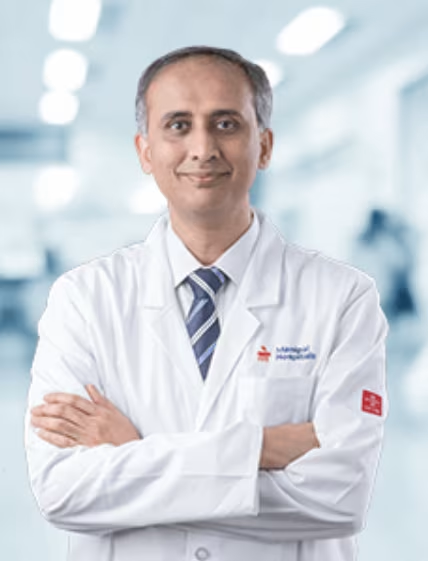
Dr. Nitin S Shetty is a top ophthalmologist in India, currently serving as the Head of Retina Services and Consultant in Ophthalmology at Manipal Hospitals, Old Airport Road, Bangalore. With years of extensive experience, he is known as one of the best and most popular retina specialists in Bangalore, offering compassionate and advanced eye care. Dr. Shetty holds an MBBS and MS in Ophthalmology and completed a Vitreo-Retina fellowship at the prestigious Sankara Nethralaya in Chennai. He is fluent in English, Hindi, Kannada, Marathi, and Tulu, making him approachable to diverse patients. He has earned numerous accolades, including the VT Joshi Award and multiple academic contributions in ophthalmology. His dedication to research, teaching, and advanced patient care makes him one of the leading ophthalmologists in India. Dr. Nitin S Shetty’s approach combines expertise with empathy, ensuring effective treatment for complex retinal diseases and uveitis cases.
Price upon request

Dr. Deepa M is a top ophthalmologist in Bangalore, currently practicing at Manipal Hospital, Hebbal. With years of experience and a strong educational background, she is known for her compassionate patient care and excellent surgical skills. She completed her MBBS from JJMMC Davangere under RGUHS Bangalore and earned her MS in Ophthalmology from MKCG Medical College, Orissa. Her senior residency at PGIMER, Chandigarh, further enhanced her clinical training. Recognized as a leading eye specialist in Hebbal, Dr. Deepa M provides comprehensive eye care services, including diagnosis, treatment, and surgery. She holds fellowship credentials and is affiliated with several esteemed medical societies, such as the Royal College of Ophthalmologists (UK), All India Ophthalmological Society, and Karnataka Ophthalmic Society. Her patient-first approach, ongoing involvement in clinical research, and commitment to modern medical practices have earned her the reputation of being a popular ophthalmologist in Bangalore. She is also known for her conference participation, poster presentations, and peer-reviewed publications, which reflect her passion and dedication to the field of eye care.
Price upon request

Dr. Ashwini P is a leading ophthalmologist in Bangalore, currently serving as a Consultant at Manipal Hospitals, Hebbal. With a medical foundation from Karnataka, she completed her MBBS and DNB in Ophthalmology and has since become a popular and trusted eye doctor in the region. Known for her compassionate care and clinical precision, Dr. Ashwini has over five years of experience in diagnosing and treating a wide range of eye disorders. She is fluent in English, Kannada, and Hindi, making her accessible to a broad spectrum of patients. Her association with renowned institutions like the All India Ophthalmological Society and Karnataka Medical Council highlights her professional credibility. Dr. Ashwini's patient-centered approach, combined with her up-to-date knowledge from regular seminars and conferences, ensures every patient receives modern and personalised eye care. As one of the top ophthalmologists in India, she is well-regarded for offering comprehensive and preventive eye care to help maintain long-term vision health.
Price upon request
Vision impairment is a major global health concern. According to the World Health Organization (WHO), at least 2.2 billion people worldwide live with some form of vision impairment or blindness. Many of these cases are preventable or treatable through timely diagnosis and appropriate ophthalmic care. Common conditions include cataracts, glaucoma, diabetic retinopathy, refractive errors, age-related macular degeneration, corneal disorders, and retinal diseases. As life expectancy increases and diabetes becomes more prevalent, the demand for specialized eye care continues to grow.
Ophthalmologists in India are medical doctors who complete an MBBS degree followed by postgraduate training such as MS (Ophthalmology), MD (Ophthalmology), or DNB (Ophthalmology). Many pursue further fellowships in subspecialties including retina, cornea, glaucoma, pediatric ophthalmology, oculoplasty, and refractive surgery. Licensing and ethical practice standards are regulated by the National Medical Commission and respective state medical councils.
India has a well-developed ophthalmology network across metropolitan cities such as Chennai, New Delhi, Mumbai, Hyderabad, and Bengaluru. Tertiary and specialty eye hospitals are equipped with advanced diagnostic imaging tools, optical coherence tomography (OCT), laser systems, microsurgical equipment, and sterile operating theaters. Many centers follow internationally accepted clinical protocols for cataract surgery, glaucoma management, retinal procedures, and refractive surgery.
Eye treatment decisions are individualized. Factors such as age, underlying systemic disease, stage of eye condition, and response to prior treatment influence outcomes. Risks may include infection, inflammation, changes in vision, or the need for additional procedures. In addition to medical and surgical care, counseling and reassurance are important, especially for patients experiencing anxiety related to vision changes. A careful, evidence-based, and patient-centered approach is central to ophthalmology practice in India.
The following doctors are listed for informational purposes only. This is not a ranking, and inclusion does not imply superiority.
Dr. S. Natarajan, MS
Specialization: Vitreoretinal Surgery
Years of Experience: 30+ years
Dr. S. Natarajan is associated with Aditya Jyot Eye Hospital, Mumbai, a tertiary eye care center. His clinical focus includes retinal detachment surgery, diabetic retinopathy management, and macular disorders. He works with advanced retinal imaging and microsurgical systems. Treatment planning includes detailed retinal evaluation and structured postoperative monitoring.
Dr. Amar Agarwal, MS
Specialization: Cataract and Refractive Surgery
Years of Experience: 30+ years
Dr. Amar Agarwal practices at Dr. Agarwal’s Eye Hospital, Chennai. His expertise includes cataract surgery, phacoemulsification techniques, and refractive procedures. Preoperative evaluation involves corneal assessment and biometric measurements to guide lens selection. Patient counseling regarding realistic visual expectations and potential surgical risks forms part of routine care.
Dr. T. S. Surendran, MS
Specialization: Pediatric Ophthalmology and Strabismus
Years of Experience: 25+ years
Dr. T. S. Surendran is affiliated with a specialty eye hospital in Bengaluru. His clinical interests include childhood cataract, squint correction, and amblyopia management. Pediatric eye care often requires careful evaluation and coordination with parents. Long-term follow-up is important for visual development and alignment stability.
Dr. Mahipal S. Sachdev, MS
Specialization: Cornea and Refractive Surgery
Years of Experience: 25+ years
Dr. Mahipal S. Sachdev practices at Centre for Sight, New Delhi. His work includes corneal transplantation, LASIK, and management of corneal infections. Treatment decisions are based on detailed corneal imaging and visual assessment. Postoperative care includes monitoring for inflammation, infection, or graft rejection where applicable.
Dr. Rupa Shah, MS
Specialization: Cataract and Glaucoma Surgery
Years of Experience: 20+ years
Dr. Rupa Shah is associated with a multispecialty eye center in Ahmedabad. Her clinical focus includes glaucoma management and cataract procedures. Care planning involves intraocular pressure assessment, optic nerve evaluation, and long-term medication monitoring. Surgical decisions are made after thorough risk-benefit discussion with patients.
| Consultation Type | Estimated Cost Range (USD) |
| Initial consultation with an Ophthalmologist | $25-$100 |
Note: Costs are approximate and provided for general guidance only. Prices vary depending on the healthcare provider, hospital type, city, and consultation format (in-person or remote). Diagnostic tests, imaging, or additional evaluations are not included. Final fees are determined by the provider after an individual clinical assessment and may be affected by currency fluctuations.
Seeking eye treatment abroad can feel uncertain, especially when vision is involved. You may be considering the surgeon’s experience, hospital safety standards, and communication clarity. Careful review of credentials and institutional capacity is important before proceeding with any ophthalmic procedure.
➤ Availability of English-speaking medical staff and professional medical translators in many facilities
➤ Specialized clinics that manage a high volume of international patients
➤ Government regulations and oversight mechanisms supporting medical tourism safety and international patient protection
➤ Structured hospital documentation, patient-safety protocols, and informed consent practices
Foreign patients should review visa and entry requirements before traveling. For surgical procedures such as cataract or corneal surgery, a stay of 7-14 days may be recommended to allow for evaluation, surgery, and initial follow-up. While English is commonly spoken in major cities, language barriers may exist outside metropolitan areas. Planning follow-up care with a local ophthalmologist after returning home is important, particularly for conditions that require long-term monitoring such as glaucoma or diabetic retinopathy.
Patients considering Ophthalmologists care in India can share their eye examination reports and imaging findings with Best Clinic Abroad to receive structured assistance in arranging consultations and understanding available options. Best Clinic Abroad acts as a medical travel facilitator and does not provide medical treatment or replace direct consultation with licensed ophthalmologists.
Who is the best ophthalmologist in India?
There is no officially designated “best” ophthalmologist in India. Ophthalmologists vary in their subspecialty focus, such as retina, cornea, glaucoma, or pediatric eye care. The most appropriate specialist for you depends on your specific diagnosis and treatment needs. When selecting an ophthalmologist, you should consider board certification, years of experience, hospital affiliation, and relevant subspecialty training.
How many ophthalmologists are there in India?
India has tens of thousands of registered ophthalmologists practicing across government and private healthcare sectors. The number continues to grow as new specialists complete postgraduate and fellowship training. Distribution is higher in metropolitan cities and tertiary eye care centers. It is advisable to verify registration with the appropriate state medical authority when choosing a specialist.
Which country has the best ophthalmologists?
No single country can be considered universally “best” for ophthalmology. Quality depends on physician training, hospital infrastructure, access to advanced technology, and adherence to clinical guidelines. Many countries, including India, have well-trained ophthalmologists and modern surgical facilities. The most important factor is matching your condition with a qualified specialist and accredited institution.
Which state in India is best for eye treatment?
Several states in India have advanced eye care facilities, including Tamil Nadu, Maharashtra, Delhi, Karnataka, and Telangana. The suitability of a state depends on the availability of tertiary eye hospitals, subspecialty services, and access to follow-up care. Instead of focusing solely on location, it is helpful to evaluate hospital accreditation, specialist expertise, and treatment infrastructure.
Disclaimer
“This content is provided for informational purposes only and does not constitute medical advice. Diagnosis and treatment decisions should be made in consultation with a licensed medical specialist based on individual clinical evaluation.”


