









Bestclinicabroad
Connect with the world's Best Clinic and doctors at Best Clinic Abroad. Your well-being is our priority, with personalized care every step of the way.


Connect with the world's Best Clinic and doctors at Best Clinic Abroad. Your well-being is our priority, with personalized care every step of the way.


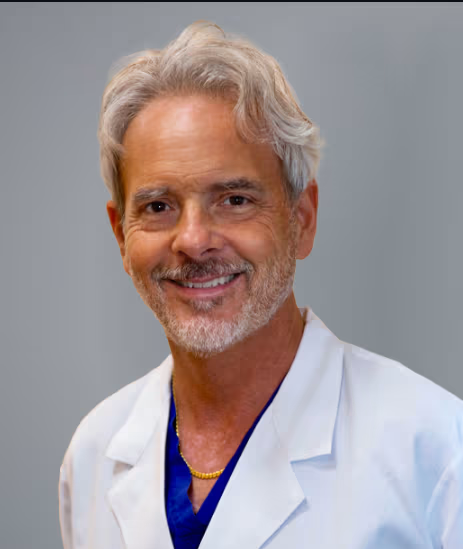
Dr. Roberto Bassani is one of the top spine surgeons in Italy, with over two decades of experience in treating complex spinal conditions. He is the Head of the Spine Surgery Unit at IRCCS Ospedale Galeazzi - Sant’Ambrogio and collaborates with Casa di Cura La Madonnina. Internationally recognized for his innovative work in minimally invasive and non-fusion spine surgery, Dr. Bassani has performed more than 3,000 major procedures, including over 900 anterior spinal approaches. He is renowned for treating degenerative disc disease, scoliosis, spondylolisthesis, spinal tumors, and vertebral trauma with innovative techniques
Price upon request
According to the World Health Organization, musculoskeletal disorders are among the leading causes of disability worldwide, with low back pain ranking as one of the most common reasons for long-term functional limitation. Degenerative spine conditions, disc herniation, spinal stenosis, scoliosis, vertebral fractures, and spinal tumors contribute significantly to global healthcare needs. As populations age, the demand for evidence-based spine surgery continues to increase.
Italy has a well-established public and private healthcare system regulated by the Italian Ministry of Health. Spine surgeons in Italy typically complete a full medical degree, followed by residency training in orthopedics and traumatology or neurosurgery, and further subspecialty exposure in spinal surgery. Many specialists work in tertiary academic hospitals and research institutes, where care pathways follow European and international clinical guidelines. Treatment planning generally involves multidisciplinary teams including radiologists, anesthesiologists, physiotherapists, and rehabilitation specialists.
Italian spine care emphasizes careful patient selection, conservative management before surgery when appropriate, and personalized surgical planning based on imaging findings and functional status. Techniques may include minimally invasive spine surgery, spinal decompression, spinal fusion, deformity correction, and tumor-related procedures. Psychological support and rehabilitation planning are often integrated into care pathways, recognizing the physical and emotional impact of chronic spinal conditions.
For international patients, Italy offers structured hospital systems, transparent consultation processes, and access to modern diagnostic facilities. Care decisions are made on an individual basis, with attention to safety, realistic expectations, and long-term follow-up planning.
Specialization: Orthopedic Spine Surgery
Years of Experience: 25+ years
Prof. Alessandro Gasbarrini practices at the Rizzoli Orthopaedic Institute in Bologna. He is known for his work in spinal oncology, complex spinal deformities, and revision spine surgery. His clinical focus includes vertebral tumors, metastatic spine disease, and reconstructive procedures. He has contributed to peer-reviewed research on spinal tumor management and multidisciplinary oncologic spine care. His approach emphasizes surgical precision and coordinated oncologic treatment planning.
Specialization: Neurosurgery with focus on Spine Surgery
Years of Experience: 30+ years
Prof. Roberto Delfini is affiliated with Sapienza University of Rome. His clinical practice includes degenerative spine disorders, spinal trauma, and spinal cord compression. He has extensive academic involvement and has participated in European neurosurgical societies. His surgical decision-making typically follows international neurosurgical guidelines, prioritizing patient safety and neurological preservation.
Specialization: Orthopedic Spine Surgery
Years of Experience: 20+ years
Prof. Francesco Fornari works at Humanitas Research Hospital in Milan. His areas of expertise include minimally invasive spine surgery, lumbar disc herniation, and spinal stenosis. He focuses on motion-preserving techniques when clinically appropriate and structured rehabilitation pathways after surgery. His clinical practice integrates imaging-based diagnosis with individualized treatment planning.
Specialization: Orthopedics and Traumatology – Spine
Years of Experience: 20+ years
Prof. Enrico Cappellini is associated with Careggi University Hospital in Florence. His clinical interests include adult spinal deformity, scoliosis, and degenerative lumbar conditions. He works within a multidisciplinary orthopedic team and emphasizes conservative care before surgical intervention when suitable. His academic involvement supports evidence-based surgical techniques.
Specialization: Neurosurgery – Spine Surgery
Years of Experience: 20+ years
Prof. Alessandro Landi practices at Policlinico Umberto I in Rome. His expertise includes cervical spine disorders, lumbar stenosis, and spinal instability. He performs both traditional and minimally invasive procedures based on patient evaluation. His practice follows structured neurosurgical standards and includes postoperative neurological monitoring.
Specialization: Orthopedic Spine Surgery
Years of Experience: 15+ years
Dr. Marco Teli works at IRCCS Galeazzi Orthopedic Institute in Milan. His clinical focus includes degenerative spine diseases, scoliosis correction, and complex revision surgeries. He participates in orthopedic research related to spinal biomechanics and implant systems. Treatment decisions are guided by imaging findings and functional impairment assessment.
Specialization: Neurosurgery – Complex Spine Disorders
Years of Experience: 30+ years
Prof. Maurizio Fornari is affiliated with Humanitas Research Hospital in Milan. His practice includes spinal tumors, complex deformities, and revision spine surgery. He has academic contributions in spine-related neurosurgical research. His clinical approach integrates neurosurgical techniques with careful preoperative neurological assessment.
Prof. Vincenzo Denaro, MD
Specialization: Orthopedics and Spine Surgery
Years of Experience: 25+ years
Prof. Vincenzo Denaro practices at Campus Bio-Medico University Hospital in Rome. His clinical interests include degenerative spine disorders, trauma-related spine conditions, and spinal biomechanics. He is involved in academic teaching and research. His care model emphasizes patient education, structured surgical planning, and rehabilitation.
Doctor listings are provided for informational purposes only and do not represent rankings or endorsements.
| Consultation Type | Estimated Cost Range |
| Initial consultation with a Spine Surgeon | $150–$400 |
Note: Costs are approximate and provided for general guidance only. Prices vary by healthcare provider, hospital type, city, and consultation format (in-person or remote). Diagnostic tests, imaging, or additional evaluations are not included. Final fees are determined by the provider after an individual clinical assessment and may be affected by currency fluctuations.
Choosing a spine surgeon abroad can feel complex. You may be balancing medical needs, travel planning, and financial considerations at the same time. It is important to review qualifications, hospital standards, and practical aspects carefully before making a decision.
➤ Availability of English-speaking medical staff and professional medical translators in many facilities
➤ Specialized clinics that manage a high volume of international patients
➤ Government regulations and oversight mechanisms supporting medical tourism safety and international patient protection
➤ Structured hospital documentation, patient-safety protocols, and informed consent practices
Foreign patients should also consider visa or entry requirements depending on their nationality. For major spine surgery, a postoperative stay of at least 7–14 days is commonly recommended to allow wound monitoring and early rehabilitation before travel. Outside large cities such as Rome or Milan, English language support may be more limited. It is also important to arrange follow-up care with a local physician in your home country to ensure continuity of care after returning.
Patients considering Spine Surgeons care in Italy can share their medical reports with Best Clinic Abroad to receive coordinated support, guidance on consultation options, and a clear starting point for treatment planning.
Do I need a medical visa to travel to Italy for spine surgery?
Visa requirements depend on your nationality and the length of your stay. Some patients may travel on a short-term Schengen visa for consultation or treatment, while others may require a specific medical visa. You should check with the Italian consulate in your country before planning your trip. Hospitals may provide documentation confirming your medical appointment to support your visa application.
Will I be able to communicate in English with spine surgeons in Italy?
Many major hospitals and academic centers in Italy have English-speaking spine surgeons, nurses, and international patient departments. In larger cities, professional medical interpreters are often available. However, outside metropolitan areas, English fluency may vary. It is reasonable to confirm language support before scheduling your appointment.
Can I arrange an online consultation before traveling?
Yes. You can arrange an online consultation through Best Clinic Abroad. By sharing your medical reports, imaging scans, and previous treatment history, you can receive preliminary guidance regarding whether an in-person assessment or surgical evaluation in Italy may be appropriate. Online consultations do not replace a full physical examination, but can help you understand possible next steps.
How long should I plan to stay in Italy after spine surgery?
The recommended stay depends on the type of procedure and your overall health. For many spine surgeries, doctors may advise remaining in Italy for at least one to two weeks after discharge. This allows for wound checks, early rehabilitation guidance, and monitoring for potential complications before long-distance travel.
Is follow-up care possible after I return home?
Yes. Follow-up care is usually coordinated between the Italian surgical team and your local physician. You may be asked to share follow-up imaging or clinical updates remotely. It is important to identify a licensed medical professional in your home country who can monitor your recovery and address any concerns after your return.
Disclaimer:
This content is provided for informational purposes only and does not constitute medical advice. Diagnosis and treatment decisions should be made in consultation with a licensed medical specialist based on individual clinical evaluation.


