









Bestclinicabroad
Connect with the world's Best Clinic and doctors at Best Clinic Abroad. Your well-being is our priority, with personalized care every step of the way.


Connect with the world's Best Clinic and doctors at Best Clinic Abroad. Your well-being is our priority, with personalized care every step of the way.


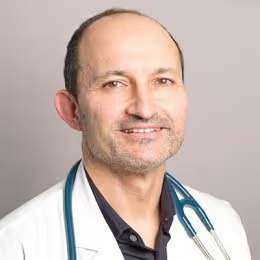
Dr. Riadh Caid-Essebsi, a leading cardiologist at the American Hospital of Paris, is widely recognized for his expertise in cardiology and cardiovascular surgery. With a remarkable history of successful heart procedures, he is regarded as one of the top heart specialists in the country. Fluent in English, French, and Arabic, he ensures seamless communication with patients from diverse backgrounds. His patient-centric approach extends beyond hospital visits, offering online heart consultations for those seeking expert advice remotely.
Price upon request
Cardiovascular diseases remain the leading cause of mortality worldwide. According to global health authorities such as the World Health Organization, conditions affecting the heart and blood vessels account for a significant proportion of premature deaths and long-term disability across both developed and developing countries. Coronary artery disease, heart failure, valvular disorders, arrhythmias, and congenital heart conditions continue to place a growing burden on healthcare systems as populations age and lifestyle-related risk factors increase. As a result, the demand for timely cardiology evaluation and, when necessary, cardiovascular surgical intervention continues to rise globally.
France operates within a highly structured and regulated healthcare system that places strong emphasis on patient safety, evidence-based medicine, and professional accountability. Cardiology and cardiovascular surgery are practiced within a national framework guided by European and international clinical guidelines, including standardized protocols for diagnosis, treatment planning, perioperative care, and long-term follow-up. Cardiologists and cardiovascular surgeons in France complete extensive medical education, specialty training, and supervised clinical practice before being licensed to practice independently.
French hospitals offering cardiac care are typically tertiary or academic institutions equipped with advanced diagnostic imaging, catheterization laboratories, cardiac intensive care units, and multidisciplinary heart teams. These teams often include cardiologists, cardiac surgeons, anesthesiologists, radiologists, and rehabilitation specialists who collaborate to tailor care based on each patient’s clinical profile. Treatment decisions are generally individualized, taking into account disease severity, comorbid conditions, and patient preferences rather than applying uniform approaches.
From an international patient perspective, France’s healthcare infrastructure is supported by transparent clinical documentation practices, regulated pricing structures, and clear standards of informed consent. Beyond clinical care, increasing attention is also given to psychological and emotional support, recognizing that heart disease and cardiac surgery can be stressful experiences for patients and families. Overall, cardiology and cardiovascular surgery services in France are delivered within a system designed to balance medical rigor, patient dignity, and long-term safety.
Professor Michel Haïssaguerre, MD
Specialization: Cardiac electrophysiology and arrhythmia management
Years of Experience: Over 30 years
Clinical focus includes the diagnosis and catheter-based treatment of complex heart rhythm disorders, particularly atrial fibrillation. His work emphasizes evidence-based electrophysiological mapping techniques and long-term rhythm monitoring. He practices at Hôpital Cardiologique du Haut-Lévêque, part of the Bordeaux University Hospital system.
Professor Alain Carpentier, MD
Specialization: Cardiovascular surgery with focus on heart valve repair
Years of Experience: Over 40 years
His clinical practice centers on surgical management of valvular heart disease, including repair and replacement procedures guided by internationally accepted surgical standards. He has been associated with Hôpital Européen Georges-Pompidou, a major academic cardiac center.
Professor Xavier Jouven, MD
Specialization: Preventive cardiology and inherited cardiac conditions
Years of Experience: Over 25 years
His work focuses on cardiovascular risk assessment, sudden cardiac death prevention, and long-term population-based heart disease management. He is affiliated with Hôpital Européen Georges-Pompidou, contributing to both clinical care and academic research.
Professor Pascal Leprince, MD
Specialization: Advanced cardiovascular and thoracic surgery
Years of Experience: Over 25 years
Clinical interests include complex cardiac surgery, heart failure surgery, and mechanical circulatory support. His practice follows established European surgical guidelines and is based at Hôpital de la Pitié-Salpêtrière, one of France’s largest tertiary hospitals.
| Consultation Type | Estimated Cost Range (USD) |
| Initial consultation with a Cardiologist | $120-$450 |
Note: Costs are approximate and provided for general guidance only. Prices vary depending on the healthcare provider, hospital type, city, and consultation format (in-person or remote). Diagnostic tests, imaging, or additional evaluations are not included. Final fees are determined by the provider after an individual clinical assessment and may be affected by currency fluctuations.
Choosing to seek cardiac care outside your home country can feel complex and requires careful thought. Many patients and families look for systems that combine clinical rigor with clear communication and structured care pathways. France is often considered by international patients because of its regulated medical environment and long-standing emphasis on patient safety.
➤ Availability of English-speaking medical staff and professional medical translators in many facilities
➤ Specialized clinics that manage a high volume of international patients
➤ Government regulations and oversight mechanisms supporting medical tourism safety and international patient protection
➤ Structured hospital documentation, patient-safety protocols, and informed consent practices
For foreign patients, practical considerations remain important. Entry and visa requirements depend on nationality and length of stay, and should be confirmed in advance. Following major cardiac procedures, a postoperative stay of at least 7-14 days is commonly recommended to allow for early recovery and medical monitoring. While English is widely spoken in major hospitals, language barriers may still exist outside large urban centers. Planning follow-up care after returning home, including coordination with a local cardiologist, is an essential part of responsible treatment planning.
Patients considering cardiology or cardiovascular surgery care in France can share their medical reports with Best Clinic Abroad to receive coordinated support, guidance on consultation options, and a structured starting point for treatment planning as a medical travel facilitator.
How much is heart surgery in France?
Heart surgery costs in France vary widely depending on the type of procedure, hospital category, length of hospital stay, and individual medical needs. Complex surgeries such as bypass or valve replacement generally involve higher overall costs due to operating room time, intensive care, and postoperative monitoring. Exact costs can only be determined after a detailed medical evaluation by the treating hospital.
Do you have to pay for surgery in France?
If you are not covered by the French public health insurance system, you are generally required to pay for medical and surgical care in France. International patients typically receive a cost estimate in advance and are responsible for covering treatment-related expenses according to the hospital’s billing policies.
Can a foreigner go to the hospital in France?
Yes, foreign patients can access hospital care in France. Many public and private hospitals have international patient departments that assist with administrative processes, scheduling, and communication. Admission requirements and payment arrangements are usually clarified before treatment begins.
Is healthcare better in France or the USA?
France and the USA both have advanced healthcare systems, but they differ in structure, funding, and access models. France emphasizes universal coverage, regulated pricing, and standardized care pathways, while the USA offers a more market-driven system with wide variability in costs and access. The quality of care can be high in both countries, and the most appropriate option depends on individual medical needs, preferences, and circumstances.
Disclaimer
“This content is provided for informational purposes only and does not constitute medical advice. Diagnosis and treatment decisions should be made in consultation with a licensed medical specialist based on individual clinical evaluation.”


