








Bestclinicabroad
Connect with the world's Best Clinic and doctors at Best Clinic Abroad. Your well-being is our priority, with personalized care every step of the way.


Connect with the world's Best Clinic and doctors at Best Clinic Abroad. Your well-being is our priority, with personalized care every step of the way.


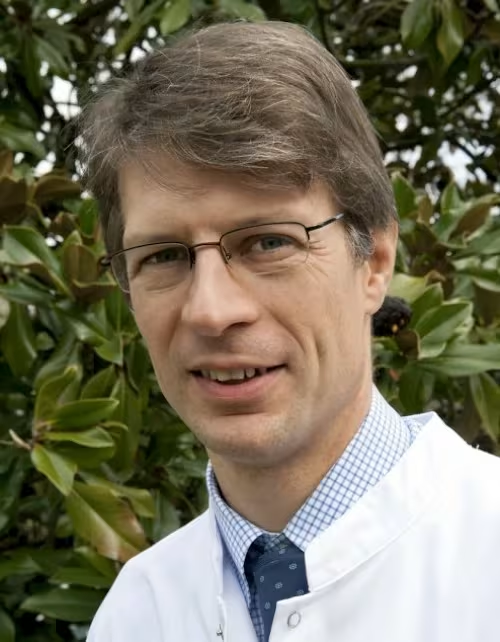
Dr. Eric Fréneaux is a leading nuclear medicine specialist in Switzerland, widely recognized for his pioneering work in molecular imaging and nuclear cardiology. With over three decades of international experience in clinical practice, research, and teaching, Dr. Fréneaux has earned a reputation as one of the best doctors in Switzerland for nuclear medicine and molecular diagnostics. His commitment to innovation and patient-centered care makes him a top-rated physician in Geneva, trusted by patients and peers alike.
Dr. Eric Fréneaux began his career as an intern at the Paris Hospitals, later joining INSERM, where he conducted research on mitochondrial oxidation of fatty acids. From 1995 to 1998, he served as a University Hospital Assistant at Cochin Hospital and René Descartes University in Paris, actively contributing to medical education. In 1998, he established and led the Nuclear Medicine Department at Ajaccio Hospital Center. He later took on leadership roles at the Clinique Générale Beaulieu, eventually becoming the head of the Nuclear Medicine Institute and later co-founding the Geneva Molecular Imaging Center (IMGE) in 2013. Currently, Dr. Fréneaux practices at the Center for Molecular Imaging and Nuclear Medicine at Hirslanden Clinique des Grangettes, where he continues to advance the field of nuclear imaging and cancer diagnostics.
Price upon request
Dr. Olivier Rager, a top nuclear medicine specialist, is renowned for his expertise in molecular imaging and oncological visualization. With a distinguished career in cancer research and advanced imaging technologies, he plays a pivotal role in the Network of Senology and Onco Gynecology of Geneva. As a leading oncological visualization doctor, his extensive contributions as a medical researcher at Memorial Sloan-Kettering Cancer Center have propelled advancements in PET/CT and SPECT/CT imaging, revolutionizing early cancer detection and treatment strategies. Recognized as one of the best molecular imaging experts in Switzerland, Dr. Rager remains at the forefront of cutting-edge clinical studies, driving innovations in Switzerland’s nuclear medicine field.
Price upon request
Cancer remains one of the most significant global health challenges. According to international public health authorities, including the World Health Organization, cancer accounts for millions of new diagnoses and deaths each year worldwide. Common cancers such as breast, lung, colorectal, prostate, and hematological malignancies continue to place a substantial burden on patients, families, and healthcare systems. Improvements in early detection, imaging, pathology, systemic therapies, and supportive care have led to better disease control and longer survival for many patients, but oncology care remains complex and highly individualized.
Switzerland is widely recognized for its highly regulated healthcare system, strong research environment, and emphasis on evidence-based medicine. Oncology services are delivered through university hospitals, cantonal hospitals, and specialized cancer centers that integrate medical oncology, radiation oncology, surgical oncology, pathology, radiology, and palliative care. Oncologists in Switzerland complete extensive training that includes a medical degree, residency in internal medicine, and subspecialty training in oncology or hematology-oncology, followed by board certification. Continuous professional development and adherence to national and international standards are required throughout a physician’s career.
Swiss cancer centers generally follow internationally accepted clinical guidelines for diagnosis, staging, treatment selection, and follow-up care. These guidelines emphasize multidisciplinary tumor boards, where oncologists, surgeons, radiologists, pathologists, and other specialists jointly review cases and agree on treatment strategies. Advanced diagnostic tools, molecular testing, and access to modern systemic therapies are commonly available in tertiary and academic centers.
Treatment planning in Switzerland focuses on personalization and shared decision-making. Oncologists typically discuss treatment goals, available options, potential benefits, limitations, and risks such as treatment-related side effects, complications, and variability in response. Psychological support, symptom management, and quality-of-life considerations are integrated into care pathways, recognizing the emotional and physical impact of cancer and its treatment.
In summary, oncology care in Switzerland is characterized by structured clinical pathways, strong regulatory oversight, multidisciplinary collaboration, and a patient-centered approach that prioritizes safety, transparency, and informed consent.
Solange Peters, MD
Specialization: Medical Oncology, Thoracic Oncology
Years of Experience: Over 20 years
Clinical Focus: Prof. Peters specializes in lung cancer and thoracic malignancies, with a strong focus on evidence-based systemic therapies and clinical research. Her work emphasizes multidisciplinary care and guideline-driven treatment selection. She practices at Lausanne University Hospital (CHUV), a tertiary academic center with comprehensive oncology services.
Manuel Battegay, MD
Specialization: Hematology and Medical Oncology
Years of Experience: Over 25 years
Clinical Focus: Prof. Battegay’s clinical work includes hematological malignancies and complex cancer cases requiring integrated medical care. He emphasizes long-term disease monitoring and supportive care. He is affiliated with University Hospital Basel, a major academic institution providing tertiary oncology services.
Roger Stupp, MD
Specialization: Neuro-Oncology and Brain Tumors
Years of Experience: Over 30 years
Clinical Focus: Prof. Stupp is known for his work in the management of brain tumors, including gliomas, with an emphasis on combined modality treatment and clinical trials. He practices at the University Hospital Zurich (USZ), a leading academic medical center with specialized neuro-oncology programs.
Doctor listings are provided for informational purposes only and do not represent rankings or endorsements.
| Consultation Type | Estimated Cost Range (USD) |
| Oncologists consultation | $200-$500 |
Note: Costs are approximate and provided for general guidance only. Prices vary depending on the healthcare provider, hospital type, city, and consultation format (in-person or remote). Diagnostic tests, imaging, or additional evaluations are not included. Final fees are determined by the provider after an individual clinical assessment and may be affected by currency fluctuations.
Choosing cancer care in another country can feel overwhelming and emotionally demanding, especially when facing complex treatment decisions. Many patients consider Switzerland because of its structured healthcare system, strong regulatory oversight, and emphasis on multidisciplinary decision-making.
➤ Availability of English-speaking medical staff and professional medical translators in many facilities
➤ Specialized clinics that manage a high volume of international patients
➤ Government regulations and oversight mechanisms supporting medical tourism safety and international patient protection
➤ Structured hospital documentation, patient-safety protocols, and informed consent practices
There are also practical considerations for international patients. Entry and visa requirements depend on nationality and intended length of stay. Cancer treatment often requires repeated visits over weeks or months, and some therapies may involve hospital stays of 7-14 days or longer, depending on treatment intensity and monitoring needs. English is commonly spoken in major oncology centers, though language barriers may exist outside large cities. Planning follow-up care, monitoring, and coordination with healthcare providers in your home country is essential and should be discussed early in the treatment process.
Patients considering oncology care in Switzerland can share their medical reports with Best Clinic Abroad, which acts strictly as a medical travel facilitator. This support can help with coordination, consultation pathways, and understanding next steps, without replacing direct care from licensed oncology specialists.
Is Switzerland good for cancer treatment?
Switzerland is known for its high medical standards, regulated oncology practice, and access to multidisciplinary cancer care. Many patients value the structured approach, transparent communication, and adherence to international clinical guidelines. Whether Switzerland is suitable for you depends on your diagnosis, treatment needs, and access to follow-up care.
Which country is best for oncology?
There is no single country that is universally best for oncology care. Outcomes depend on factors such as specialist expertise, hospital infrastructure, access to modern therapies, and patient-specific characteristics. Countries with strong regulation, academic cancer centers, and multidisciplinary care models, including Switzerland, are often considered by patients seeking reliable cancer treatment.
Disclaimer
“This content is provided for informational purposes only and does not constitute medical advice. Diagnosis and treatment decisions should be made in consultation with a licensed medical specialist based on individual clinical evaluation.”


